
A Life-Changing Opportunity
After attending the meditation classes offered at the Sri Chinmoy Centre and experiencing for myself the lasting peace and inner happiness that was beginning to bloom in my life, I was growing an inner hunger to discover more about spirituality.
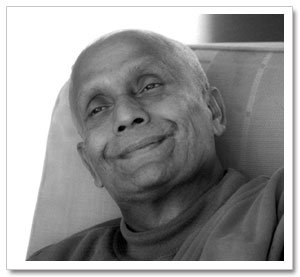
Sri Chinmoy meditating...
I had developed a deep respect for Sri Chinmoy and his students I had met. Everything they embodied, everything that I heard about Sri Chinmoy, and the books I had read portrayed such vastness, wisdom, purity, and sincerity. I appreciated how open this path was to all religions, cultures and other spiritual paths and teachers. I was very inspired by how active and involved in the world Sri Chinmoy and his students were, undertaking such significant and effective endeavours as the World Harmony Run, humanitarian aid programmes, worldwide free meditation classes, peace concerts, hosting running events and ultra marathon races - all purely for the selfless purpose of inspiring humanity with a message of transcendence and to spread hope, love and oneness for a more harmonious world.
When I was given the opportunity to become a student of Sri Chinmoy and receive personal guidance from such a genuine spiritual teacher I embraced this whole-heartedly. I was absolutely certain that he had a great deal of wisdom-light and inner guidance to offer me on my life’s journey. At the time I had no idea of the unbelievable fast track having a spiritual teacher could be for my progress towards self discovery and God-realisation. Now I can see that this one decision in my life has expedited my progress unimaginably and opened up the most self-expanding, meaningful and fulfilling life.
From marathons, meditation retreats, and travelling to New York to visit Sri Chinmoy, singing performances, plays and World Harmony Run experiences, everything we do is motivated from a striving force within to transcend ourselves and become our highest potential. Joy and delight in living is always a priority in our lives. I would love to share a few of my experiences of the fullness and joy of life now that I am a student of Sri Chinmoy’s. I hope you enjoy.
Back to: My Articles and Stories.
My God-Hunger-Cry - by Sri Chinmoy

In October of 2005, Sri Chinmoy began a series of prayer-poems entitled My God-Hunger-Cry. We are delighted to feature them here and hope they bring you joy and inspiration.
Dream Songs
This is one of the stories in our Story-Gems project, a collection of our experiences with our Guru, Sri Chinmoy. Project homepage »
Spiritual masters communicate with those around them in many secret ways – especially with those that have, or are destined to have, some inner or outer connection with the Master, such as becoming his disciple. In dreams, visitations, meditations, through sudden inspiration or lucid moments when the soul peeps out, this communication occurs, bypassing language and mind.
Even to those slow to comprehend such things – I often count myself here – the evidence of this inner reality mounts up over the years. In 1980, for example, at the very beginning of my journey I sent a grainy photo of my wife and myself – sitting cross-legged in a painful half lotus on a wooden floor – to enquire of Sri Chinmoy whether his spiritual path was meant for us. It was, but I still needed convincing, a laggard mind trailing well behind the front-running soul.
In a rare and subsequent dream one night, he came to me exactly as I would see him later and asked me to sing three songs in Bengali. And in my dream, seated around a long table with forgotten others, I promptly rose and sang these required three songs in this language of which I knew not a single word. In the morning, awakened, I was filled with a strange delight and knew something most significant had taken place, as is usually the case with dreams involving spiritual Masters.
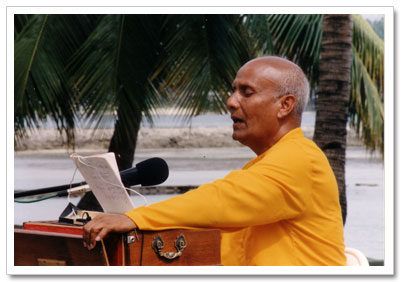 Three months passed and now I was in New York, dream long forgotten, seated in a public school auditorium for my first encounter with Sri Chinmoy and an evening of meditation. Later he began teaching songs, inviting us to learn and sing, and I gamely joined in, jotting the words down on a pad and trying to stay in tune.
Then a revelation, the floodgates of memory opening and I was recognising with complete clarity that the three songs I was singing were the three songs I had sung so fearlessly and perfectly in my months-ago dream.
Then more. Filing by with others to accept an item of fruit from the seated teacher, he glanced at me as he placed an orange in my hand and said with a very broad smile “Well?” The reference to the dream and the reappearing songs was unmistakable. Now I was smiling too, smiling at this first glimpse into a new world of mystery, wonder, reassurance and delight.
Inner Worlds – Outer Worlds
For anyone associating old age with physical decline, 75 year old Indian luminary Sri Chinmoy is a refreshing dose of inspiration. The prolific author, artist, musician and spiritual leader has recently sent the word 'impossibility' into orbit with a number of age-defying feats of strength that have had world strength athletes gasping for superlatives.
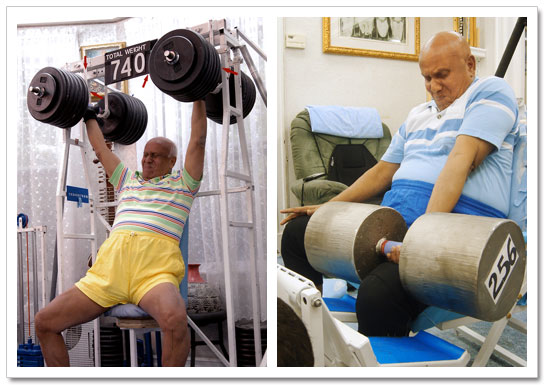 Athletes have long known of the relationship between mind-body-spirit in sporting success – the principle of holistics – and practioners of yoga and meditation have for centuries championed this principle as essential to a balanced life and to happiness. Seventy five year old spiritual master Sri Chinmoy has attracted renewed interest and attention in the mind-body connection with several astonishing recent feats of strength, all attributed to the power of prayer and meditation. He hoisted two huge dumbbells weighing 740lbs overhead from their cradle on a custom-built exercise machine, then went on to wrist-curl – 10 times with each arm – a record 256lb dumbbell.
"Out of all the weightlifters and champion bodybuilders I have seen," responded weightlifting authority and Mr. Olympia Contest Chairman Wayne DeMilia, "Sri Chinmoy is the only one I have ever seen wrist curl a 200lb. dumbbell."
Why does Sri Chinmoy bother to lift these super-heavy weights?
"What I wish to show by these feats of strength is that prayer and meditation can definitely increase one's outer capacities. I hope that by doing this I will be able to inspire many people to pray and meditate sincerely as part of their regular daily routine... The physical body has to become a pure and perfect instrument of the spirit. I am doing these lifts with the physical body, but the strength and power are coming from within – from an inner source."
In explaining the unlimited potential of each and every human being Sri Chinmoy refers often to an 'inner world' accessible through meditation, where power, cosmic energy and inspiration are concealed. We can draw upon this cosmic energy by entering into our deeper consciousness, the all-pervading consciousness, which is here, there, everywhere. "It is the inmost consciousness that touches the springs of the cosmic energy," he explains. "If we can have a free access to our inmost consciousness, the cosmic energy is bound to come to the fore. If we go deep within, it comes like a spring, a never-failing spring. And when it comes, it permeates the whole body."
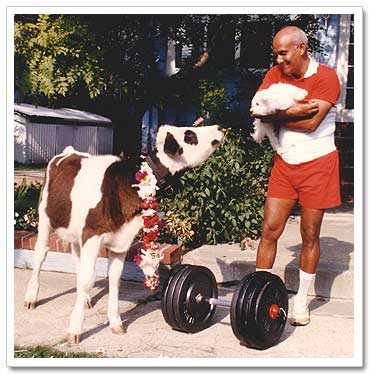 Regarding his recent weightlifting achievements – dedicated simply to inspiring others – Sri Chinmoy distinguishes between strength, which is finite and limited to the physical realm, and power, which has a higher and deeper source. Strength is an outer achievement, power is an inner achievement. If there is a tug-of-war between strength and power, power will always win, for the source of power is infinitely greater than the physical strength that any human being can have.
When we use the word 'strength', we usually refer to the physical strength, the vital strength, the mental strength or even we go as far as the inner strength. When we use the word 'power', we indicate a capacity of one's inner being. For power, unlike strength, immediately gives us the feeling of an essential aspect of God. Its home is high, very high, in the loftiest regions of the infinite Consciousness."
The limited mind and body can thus be transcended through prayer and meditation, and what today may seem like miraculous achievements can become everyday realites as we gain access to these higher and deeper capacities inherent in our nature. Sri Chinmoy speaks too of the force of faith, and love of God, as keys to the inner world and notes, with beautiful simplicity; "Impelled by His strongest compassion, God takes the feeblest man into His omnipotence."
In a lifetime devoted to fostering the spiritual awakening of humanity, Sri Chinmoy encourages a holistic approach to wellbeing, happiness and spiritual progress – exercise brings physical excellence and health to the body-temple; service to others widens our heart and deepens our oneness and compassion; spiritual music and literature nourish and illumine our minds; meditation brings to the fore the peace and happiness of the soul.
Sri Chinmoy's recent weightlifting achievements encourage us not to grow old, to dare to tackle new challenges, to believe in our own unlimited potential – the fullness of life, he tells us, lies in dreaming and manifesting the impossible dreams.
"And I tell the citizens of the world only one thing: never give up, never give up! Physical fitness is of paramount importance. There is no age limit when you live in the heart and when you try to be of service, prayerful and soulful service, to God in humanity."
– Jogyata.
All quotes on this page are by Sri Chinmoy.

Past Lives
Disciples of various paths and various masters love speculating about past incarnations they have had; and our path and those who follow it are certainly no exception.
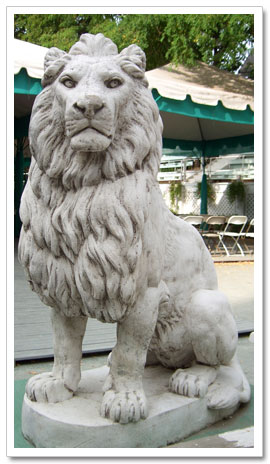 For the most part we like to imagine that our past lives have been generously sprinkled with regal, spiritual or statesmanlike incarnations although in Auckland much unflattering speculation has circulated about the likely former lives of other centre members and I have often tossed and turned in my bed at night, bristling with indignation at remarks about my ancestry.
I remember, incidentally, at the Auckland Zoo in 1995, Sri Chinmoy giving a spontaneous and wonderfully moving talk before an enchanted audience of about one hundred people, including the delighted head zoo keeper, about the connection between the human world and our distant relatives in the animal world of the zoo.
My good friend Prachar a member of the Sri Chinmoy Centre in Canberra in Australia, owes me an eternal debt of gratitude for some insights he has regarding one of his former incarnations. Once while we were playing tennis together in New York, I loudly commented on my magnanimity in playing with a reincarnated rodent (yes, him!).
This joke was somehow relayed to Sri Chinmoy and after some deliberation this spiritual Master who can see very clearly back into time corrected my facetious judgement and revealed that, no, in fact Prachar had been... – but wait, I feel I should stop here and not divulge this truly sensational titbit!
I too would like to think that I was a great yogi or an emperor or at very least a hugely important political figure in a recent incarnation but sadly I know that this was not the case – at least some of us must have been among the anonymous and nondescript millions who came, saw and did not conquer, leaving this world unknown.
You must read Sri Chinmoy's book Death and Reincarnation sometime – compulsory reading for anyone wanting to understand the great 'life / death / more life' conundrum.
My father loved the great outdoors and my soul’s choice of parents indicates a formerly rural, outdoorsy incarnation - on my fifteenth birthday I was given a large birthday package which I mistakenly thought was a cricket bat but which turned out to be a high powered hunting rifle. For the next few years I roamed the mountains near my hometown terrorising my distant relatives in the animal kingdom and hunting anything that was marginally edible. I loved riding horses and vast open spaces and solitude – Gosh! I must have been a cowboy!
After my discipleship began, a certain lingering attachment remained in my heart for nature's majestic, uncluttered landscapes and I had to consciously turn away from this nostalgia for another time, another self, another life and refocus on the here and now. Robert Frost's lines often echo in my mind: "The woods are lovely, dark and deep. But I have promises to keep, and miles to go before I sleep."
This calls for a short poem of my own!
PAST LIVES
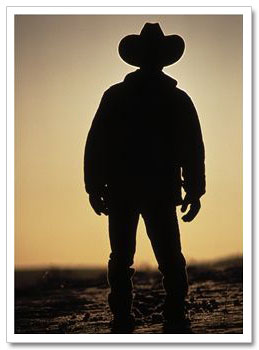 Boothill, buzzards, buttes, badlands,
an old shack on the river’s edge
and the lazy brown hills
climbing away into pale silhouette
high blue, faraway.
And at dusk
smoke from the fires,
saddle smells, carbine and cordite
sweet earth
and the fragrant wind out of the dark.
Then the long nights
strewn with stars,
almond blossom white and bright
in the cold vault of sky.
Yes, I remember, I remember.
Ride on ghost cowboy,
this life ain’t big enough for both of us.
– Jogyata.
Ode to a Turkish Rug

photo by Sharani
Before I even arrived in Turkey, I was hearing tales that this country is a veritable shopping mecca. I imagined that the daunting shopping opportunities in Turkey – Istanbul in particular – might be for several reasons.
First there is its vantage point as the crossroads of two continents, Asia and Europe. Secondly, there is the legacy of the old Silk Road trade route and lastly its geographical supremacy from a nautical perspective bordering the Mediterranean, Black and Aegean Seas.
From the viewpoint of a vistor to the country, perhaps nothing has greater iconic cultural status in Turkey than the Turkish rug. Even though I had images of flying carpets and Arabian nights in my limited sense of Turkish culture and history, I planned at most to buy some small trinkets for co-workers along with a box of Turkish delight that would conjure up images from C.S. Lewis’ story The Lion, The Witch and The Wardrobe. I certainly did not plan to come home with a rug.
“Where are you from? How long are you visiting here? Would you like me to help show you the Hagia Sophia? Did you know this building dates from…? Would you like to come see my family’s store and have some tea? Would you come put an American quarter on my map that shows where different visitors are from?”
A somewhat seasoned traveller’s perspective held me in good stead while encountering the wandering merchants while seeing the sights of Turkey. During my first two days spent in Istanbul, I quickly acquired my own firsthand lore about rug merchants in particular which was supplemented by advice from other friends sharing our retreat with spiritual teacher Sri Chinmoy and his students from many different countries. Two words sum up the advice – buyer beware!
My rule of thumb as an American quickly became that if someone approached you and spoke good English then you knew they were going to invite you to their carpet store if you engaged them in conversation regardless of the initial pretext for chatting. In fact, my experience was that most people did not speak English in Turkey with German being the much more common nationality for tourists. People trying to sell rugs, however, spoke good English.

The Grand Bazaar - photo by Sharani
We even had the experience of trying to find the Grand Bazaar on foot after leaving the Topkapi Palace and no less than a half-dozen people were telling us (in English) to go in the exact wrong direction to a section of Istanbul where we later discerned these rug merchants were concentrated. We ignored their advice and persevered in the correct direction until we arrived at the Grand Bazaar – yes shopping mecca would not be an understatement for a place that includes thousands of shops and hundreds of streets all interconnected in the heart of Istanbul. Tired after an already long day of touring, we barely did it justice.
Instead, shopping for souvenirs waited until our more leisurely and longer sojourn in Antalya, a seaside town on the Mediterranean – called both the Turkish Riviera and the Turquoise Coast. We soon determined that bargaining is de rigeur and that the people who sit on the front stoop of the stores must be ruthlessly, if politely, ignored or you will be pulled into situations you would rather avoid. While I may be painting a rather dour picture, I can try to balance what I say by praising the many beautiful items in the stores – shawls with nicer designs than I have seen in any other country and a shopkeeper who willingly and affordably custom-sewed an over-the-shoulder small pocketbook with an elephant print that was only featured in a different larger style in existing stock at the store.
And then somehow this jaded and adamently rug avoiding tourist stepped into a Turkish rug shop. How pray tell did this happen? Well one of my travelling companions was considering buying a rug for her mother’s apartment and the store that we became brave enough to walk into turned out to have articles displayed just inside the entry written about this exact rug store owner from the New Yorker magazine as well as National Geographic magazine. Like a fresh drink in the desert, the New Yorker article immediately stated that this rug merchant was impeccably honest, hated to bargain and wouldn’t even sell a rug to someone whose energy didn’t resonate with him. The German Shepherd on the doorstep mentioned in the 2000 article was in said spot here now in 2006 as well.

photo by Sharani
So we met Mehmet Saggun of the Orient Basar and learned about Turkish rugs and shared information about Sri Chinmoy’s love of tennis with this former regional tennis pro. In retrospect, our meditative approach seemed agreeable to his supposedly reserved demeanor and those of us who purchased a rug even succeeded in bargaining to a lower price – The New Yorker article to the contrary. In my case, I ended up with two small prayer rugs for the price of one that I planned to give as gifts. One had a design that reminded me of Navajo Indian/American Southwest which I knew would look perfect in my parents’ house in Arizona.
I ended up giving the other rug to my neighbor across the street who so expertly watches over my house, starts up my car, etc. during the duration of my long trips. Usually his only desired gift is a box of liquor-filled chocolates. Every other thing I have ever brought him fell flat and he declared that this type of chocolate was the only gift he would ever want. This year, the duty-free shop explained that I could not even bring such a purchase on the plane because it fell under the category of unallowed liquids in carry-on baggage! Arriving home without a box of chocolates, I gingerly listened to my intuition which said to just bring over the rug and ask him if he and his wife honestly liked it. They loved it – as did my parents as well.
I guess it is "not for nothing" that some items garner iconic status. These hand-knotted all-wool rugs were truly beautiful and are perhaps the best-received gifts I have ever offered upon return from my sojourns around the world. For this reason, I am especially grateful to have discovered this merchant dubbed “The Rug Missionary” by Michael Specter in his New Yorker article.
And I close with confession that I also bought a small rug to keep for myself which beautifully adorns the floor of my meditation/shrine room. It is Kurdish and contains a glorious combination of colours – pink, orange, green, red – colours like no other rug in the store that I saw that day.
When you see it you know it. The rug which carries you on a flying journey rich with beauty and satisfaction. A Turkish rug can carry magical beauty. Search carefully and remember that sometimes icons receive their monikers for real reasons and you will treasure them deeply once you wipe away the tarnish of cliché and truism misleading you on their surface.
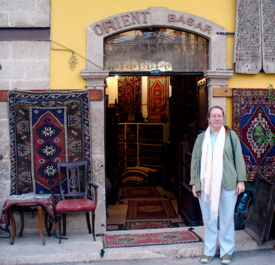
Me at the Orient Basar - photo by Virangini
New Year Odyssey
Last day of 2006...
Nine boys from our Auckland Sri Chinmoy Centre are spending a few days away over New Year, an unhurried ramble by car, looping 700 miles around the northern part of New Zealand. No maps, no plans, the winds of impulse and whimsy filling our sails. I love landscapes, opt to sit in a back seat exempt from chatter, watch instead the ever new beauty of life unravelling all around. We head north early, over the arched spine of the Harbour Bridge and out through multiplying suburbs, industrial estates, a green field dotted with white cricketers, someone running up to bowl.
Then slowly for a time through motorway construction, yellow clay scraped bare, black irrigation piping coiled like sleeping anacondas, a tired all night crew flagging us down. Out at last into country, a hawk scrambling up from a roadside mat of fur and bone, calm fields of contoured grasses, yellow bleached under the harsh burning of summer. Squat grey pylons march away across farmlands, raptor shapes, skeletal hanging arms dragging cables across valleys, on down to the coast, the shoreline's musket blaze of scarlet blossoming pohutukawa, coruscations of light through fast-tracking trees, glimpses of shimmering grey-blue sea, the pencil lines of pale islands at furthermost rim of earth. Gumbooted fishermen, redolent of cod and gasoline, fix roadside signs – oysters, scallops, fresh fish, crays, this mornings catch.
 North we go, a caravanserai at the waning of the old year, travelling a sweet-flowing road that curves like a ribbon through soft hills on into another year of promises and hopes and surprises. Contours of hills free flowing too, the smooth nape of earth, overlapping ridgelines folding into step-back silhouettes against pale sky. Skylines merging, blending like folded arms.
Now at a junction we turn down a dusty gravel road towards the sea, stones pinging off the metal underbellies of the cars. A wide tidal flat, beyond calm sea; swimming and playing for an age in the clear waters. Two hundred metres from shore thousands of black seabirds slash and scavenge, dense-packed over a sea boiling with harried silver fish, shoals herded by the lightning blur of kingfish – in depths of sunlit jade the dark lurking of dolphins. The sea churns in a frenzy of living and dying, the unabating raids of gape-jawed predators tearing through the panicked, huddled shoals.
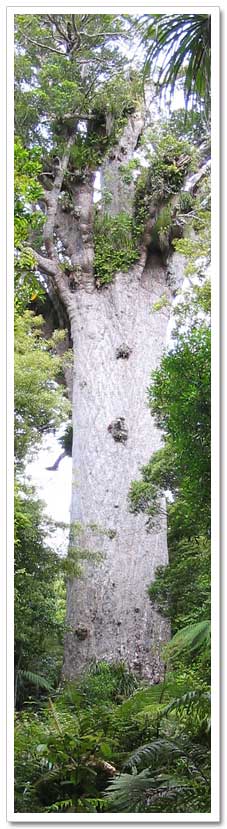
At Dargaville, two hours north, a lunch break in a café then on to Waipoua Forest, home of the largest kauri remnants, a range of folded mountains where kiwis still thrive. Here a glimpse into a beautiful past. The great tree monarchs seem more of stone than sap and wood, the dark scales of bark with their smooth hammer-like indentations the armour of some prehistoric thing. Two thousand years old. Bashful snaps of tree-hugging, Tarzan poses, swinging from vines trailing down from the wide spreading crowns where nests of hanging ferns bunch and thrive.
A cellphone rings, a voice asks where are you? Danny lost out there on a country road in a big wide valley dotted with Lilliputian cottages and hay barns, crouched over a map spread across the hot car bonnet. Coursing like hares down country lanes till we find him. There he is, lounging beneath the shade of an acorn bough, all around poplars and the grandeur of old kapok trees, drizzle of white fluff like snow banks lining the roads. In an empty nearby paddock an old homestead with rusted roof, open doorways and gaping windows like empty eye sockets, poignant shell of a dead generation, imagining autumn winds howling through. And as always never far away, the jumbled skyline of forested mountains with their variegated greens and deep shadowed valleys while above the wind brushed skeins of summer cirrus.
Evening is creeping in. We drive up another gravel road to our lodgings for the night, Okarito Lodge, bunk beds and a communal kitchen on the side of a mountain, either this or camping in a lumpy paddock somewhere down the line. Andy our bearded host stands on a hillock looking at his vege garden and I ask him about the local hills. Mistake. He's off and half an hour later he's still hard-talking, of Maori legends, opossum populations, pig hunts, the family genealogy, tractors, his early years truck-driving in Queensland, his most memorable fishing expeditions, daughter doing well at Uni, organic gardening, neighbours good and bad, his private arsenal of firearms – an old snipers .303, some illicit stuff that draws a conspiratorial wink, several shotguns in varying gauges, a short barrelled scattergun for night prowlers. Yeah, he says, you wouldn't believe about that...
Anecdotes too about each of the derelict car wrecks up in the back paddock, wheels gone, hoods up, dissolving into rust and long grass and rain – I can tell you a story about them, he warns, does that, on and on. I'd like to say, they're an awful eyesore Andy, get them to a wrecker but Andy won't pay heed to an upstart city slicker. Then reminiscing about a long-ago cattle muster still seared into memory like a branding iron, herding a half-wild mob out of the steep bluff country and dark forest and the new shepherd's dogs pushing too hard, fifty head of cattle over a cliff in the dark.
My local knowledge is now encyclopedic – a book maybe? Andy barely notices when I thank him and walk away, he still tugging at sentences, eyes self-absorbed and immersed in the long unfurling of his life.
 A late awful dinner of baked beans and hard potatoes, lashings of redemptive pasta almost cooked. That night, mind still reeling from Andy's expletives and blowtorch life, I dream of riding at the rear of 400 bush cattle, straggling down late under blazing stars, a fern-lined ridge track, dark banks of glow worms, mud a foot deep, trail jammed with steaming, bawling cows but stop before reliving their awful plunge.
Then to wake around 3am, seized by hunger. Pitch black night. Stumbling around, careful not to wake the other's heavy breathing, bemused by the unfamiliar bunkhouse, hands sliding across the walls, searching for things that might give a clue to lights, doors, windows. Morepork are calling from the invisible folds of hills, rain is thrumming on the sheets of fibrolite roofing, curtains of grey sliding over the dark land. First dawn of the New Year. Across the tops of plum trees, cloud blanketed valleys far away materialize out of night, the slow contours of dark hills against a paling grey sky.
We sit in plastic chairs on the wooden verandah decking to meditate. Sri Chinmoy's photo in my much-travelled portable shrine is there before me on the balustrade, a reminder of what for me is ultimately and only real and true, and then, too, of what is not real and not true in the endless verisimilitude of life. Then to sing one song while incoming dawn extinguishes stars, light flowing above the orchards, magpies caroling over in the paddocks and pines. The first day of the New Year, but I make no promises – though hopes still linger. Especially the one that I never forget why I am really here, another that I never break the golden cord that ties me to my teacher. And, though less importantly, the hope to sometimes enjoy (at least a little) playing leading man in the awkward drama-dream of my own life – yes, to be happy!
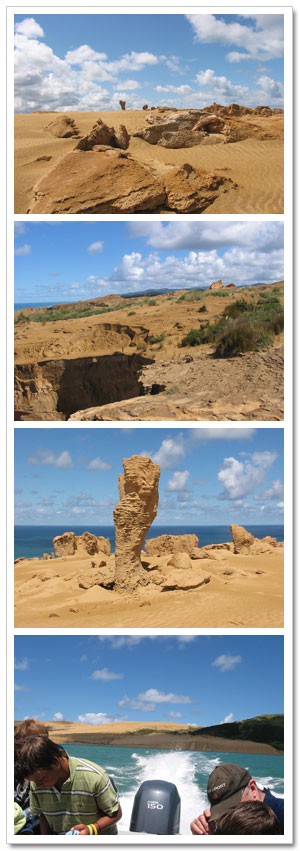
Breakfast – another attempt at last night's failed potatoes – a forest run then a cold-water shower. The electricity has gone out during the night when a reveler drove into a power pole. Mid-morning we cross the Hokianga harbour by boat, the receding crest of our wake a white road across a beryl green sea, waves slap-banging on the aluminium hull. Across the wide harbour sun-flooded golden dunes shine wave after wave, banking up 800 ft to a high smooth skyline – far above, cloud wisps hang like condors riding thermals, hovering high up in the blue. Ashore, steep golden sand hills plunge into the sea and we slide down them endlessly on curled boards, the velocity carrying us 30 metres out into the clear tide. Screams of other children skimming out into the harbour's lazy calm.
I trudge up to the far skyline, a half hour slog, up to a place of beauty and isolation and vistas, feet bare in the warm yellow sand. From a high outpost you look north along 70 miles of shoreline, the deep blue ocean a vast tablecloth rumpled with white borders where slow rollers break. Past here, the winds have scoured the plateau back to bony outcrops, ironpans, strange shapes of sculpted harsh sandstone. Here too, raw and deep ravines, cavernous wounds gouged out of the headlands by something inexplicable, sink holes where you would never be found nor find your way out of if caught, blocks of misshapen sandstone, deformed and malign. An eerie place of troubled landscape, den of spirits.
From far up on the skyline I see our Maori boatman returning, a faraway silver dot inching across an emerald meadow, a meteorites white tail across the falling green tide. At last the bow crunching onto the sand. Good natured and with a raft of local jokes, our pilot looks unwell; the last hours of the old year saw much unbridled revelry and the first hours of the new year are exacting their toll.
Patvakan's car is having problems and in the village of Opononi, we switch from four to three vehicles, abandoning the old Honda in a gravel yard. The kind local dairy owner points to the back of her section for safe keeping – tomorrow we'll be back through.
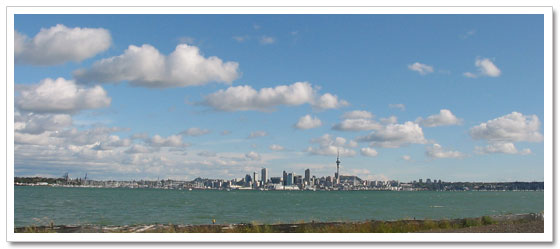
And here we split up, myself with two friends one-way, the others turning at a road fork to the north. Four hours down the eastern side of the island we go, through small rural villages where Maori families grow corn and potatoes, trap eels in the creeks, then coastal holiday towns filled with shoppers, jandaled strollers, nut-brown, neat rows of boats in marinas. At last home, glad to be back in my own place.
Wandering the nooks and crannies and beautiful places of earth is fun, though only offers a brief reprieve from the serious stuff of attaining that other and more fulfilling freedom at the end of all striving. The Greek poet Cavafy reminds us of this: "No ship exists to take you from yourself." And this from Sri Chinmoy's vast anthology of writings and gold nuggets on freedom:
Earth -freedom:
Disastrous madness.
Heaven-freedom:
Harmonious oneness.
God-freedom:
Prosperous surrender.
But it's nice now and then to break out and roam to a far horizon...
– Jogyata.
- ‹ previous
- 259 of 337
- next ›

Except where explicitly stated otherwise, the contents of this site are licensed under a Creative Commons Attribution-NonCommercial-NoDerivs 3.0 Unported License. read more »
SriChinmoyCentre.org is a Vasudeva Server project.